
75-ball bingo columns: put the number in the right letter range
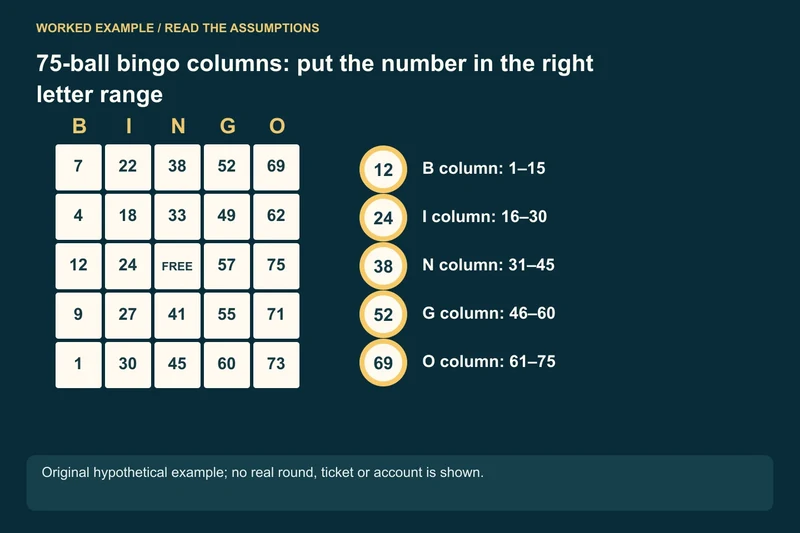
On a standard 75-ball BINGO card, the letter narrows the number range. A call of G52 belongs in the G column. Finding 52 somewhere on a copied grid is not enough if the grid puts it in the wrong column.
For the topic overview, see Detailed guides.
The ranges also help check a transcription before interpreting a pattern. They are a format check, not a method for choosing more likely numbers.
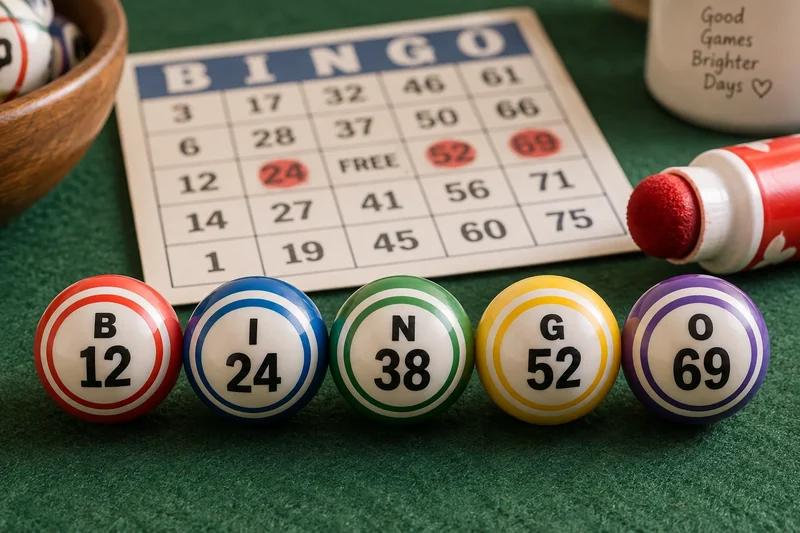
Five columns, five ranges
Mecca’s guide to bingo formats describes the five-column 75-ball card and its free centre. The conventional ranges are shown below. This article uses that format; special variants can use a different design.
| Letter | Allowed numbered values | Example |
|---|---|---|
| B | 1–15 | B12 |
| I | 16–30 | I24 |
| N | 31–45 | N38 |
| G | 46–60 | G52 |
| O | 61–75 | O69 |
Check the boundary values
15 belongs to B; 16 belongs to I. Likewise, 30 stays in I and 31 starts N. A common copying mistake is to start each range at a multiple of 15 instead of ending there. That would move the boundary numbers into the wrong column.
Take the invented row 12, 24, 38, 52, 69. It passes the five range checks in B-I-N-G-O order. Now swap 24 and 52. The set of numbers is unchanged, but the row no longer fits the column format: I52 and G24 are both out of range.
A call must match a printed number
A valid range does not guarantee that the called number appears on a particular card. G52 identifies a possible location, not a mark on every G column. If the card’s G values are 47, 50, 54, 57 and 60, a G52 call marks none of them.
Conversely, replaying the same call does not create a second 52 on a card. Keep one status for the printed cell. The mark follows number identity, not how many times the sound or notification was replayed.
Range validity is only the first check
Before assessing a saved card, keep its ticket identity, round and printed values together. Check column ranges, then compare actual numbers with the call record, then compare marked positions with the required pattern. Those are three separate tests.
The free centre is a position, not a numbered N entry to invent. A cropped card that hides a letter or value should remain incomplete until the original can be checked. Passing this worksheet establishes that a transcription fits the chosen layout; it does not validate a ticket or prove that a prize was won.
The phfun homepage brings together the site’s other reading topics.
Source-based editorial research and original examples. Sources checked 9 October 2026. No real-money play or account transaction was performed for this article.