
Bingo pattern complete on call 31: why a call-30 deadline still fails
Published — UTC
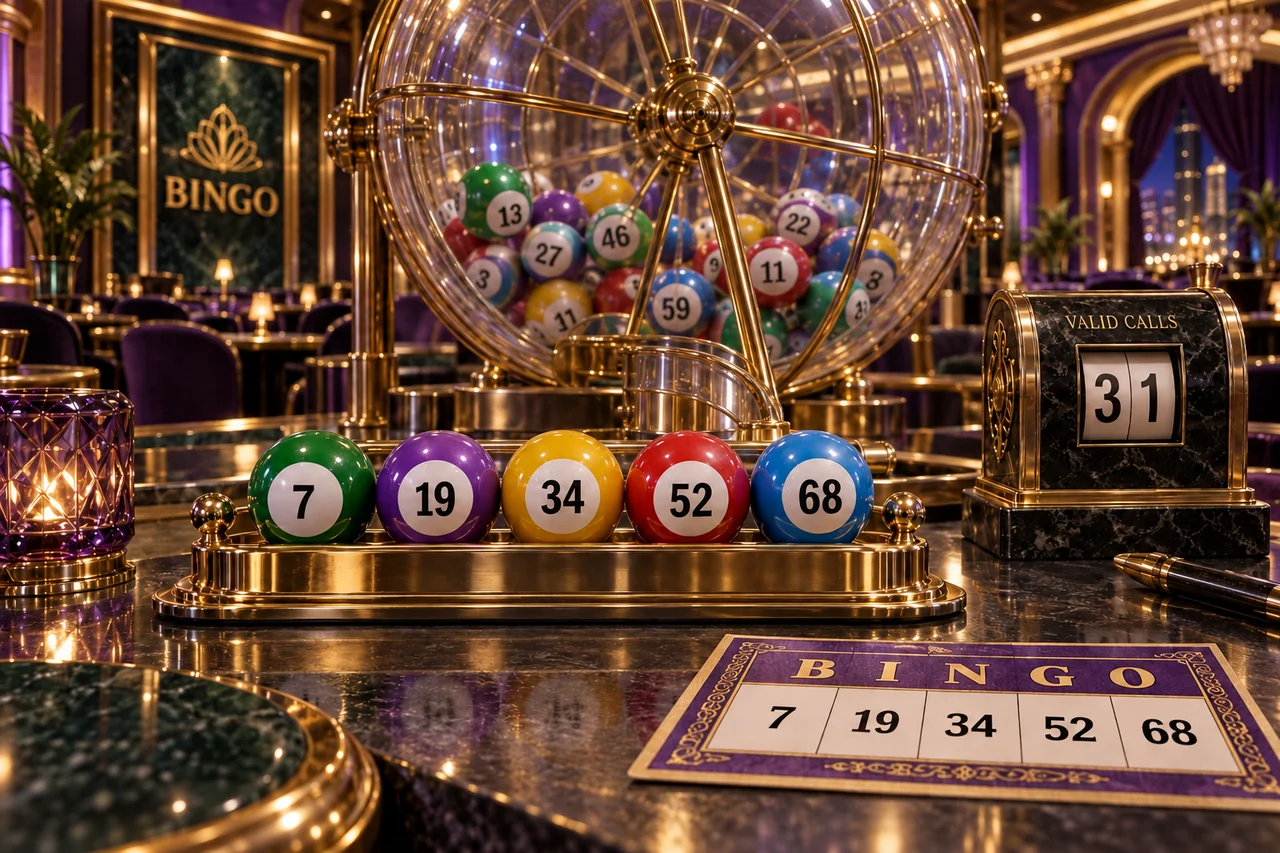
A bingo pattern can be complete while a time-limited prize condition is not. If a rule says the pattern must finish by call 30, the missing square arriving on call 31 changes eligibility even though the final card looks identical.
Keep the call sequence alongside the shape
Our fictional condition requires five specified card positions to be marked no later than the thirtieth valid call. There is no free square in this particular pattern. The relevant numbers arrive at calls 4, 11, 18, 29 and 31.
| Checkpoint | Required positions marked | Pattern complete? | Complete by call 30? |
|---|---|---|---|
| After call 29 | 4 of 5 | No | No |
| After call 30 | 4 of 5 | No | No |
| After call 31 | 5 of 5 | Yes | No |
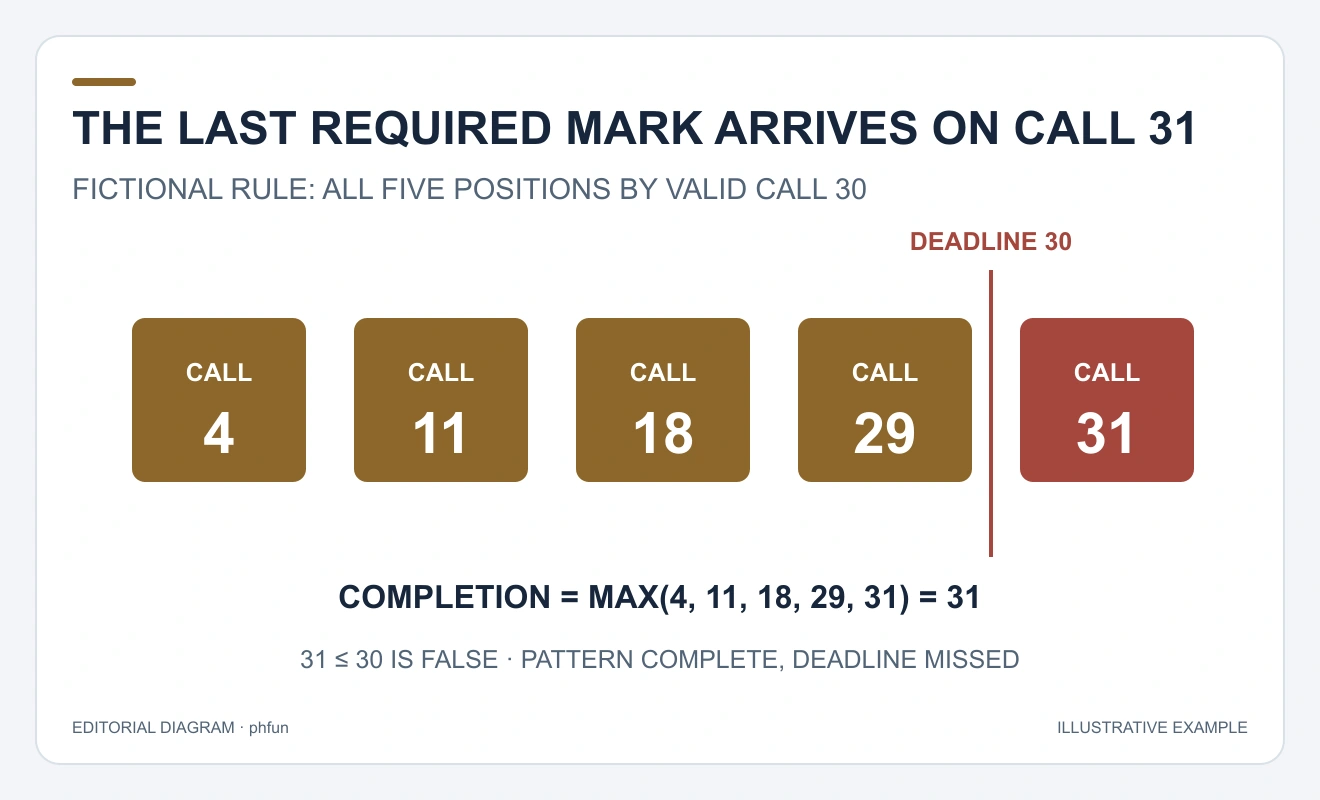
If the final required number had arrived at call 30 instead, both conditions would pass. The boundary is inclusive only because this invented rule explicitly says “no later than.” An actual rule saying “before call 30” would need a different comparison.
The counter needs a definition
A repeated notification is not automatically another valid call. A counter can also display a countdown, the next call or a completed-call total. Record what its label means before treating the screen number as the sequence index.
Identify the game, round and card. A call list from another round cannot supply the missing final number, and a completed pattern on another card cannot complete this card’s condition.
Check two facts independently
Retain a pattern diagram and a call-history extract. The first proves which positions matter; the second shows when they were marked. The British rules-disclosure reference supplies context for defined winning conditions, without verifying a local bingo prize.
Attach each call to a particular card position
For an explicit fictional row, let the required printed numbers be 7, 19, 34, 52 and 68. They arrive on valid calls 4, 11, 18, 29 and 31 respectively. Ball number 68 is therefore marked at call index 31; the two numbers identify different things. The cover illustrates the printed numbers, while the diagram shows the call indices.
When all required positions have a valid mark, the completion call is the largest of their first valid mark indices: max(4, 11, 18, 29, 31) = 31. Repeatedly seeing number 7 after call 4 does not move its first mark later or supply number 68.
A free position changes the required set
If another game treats one square in the target pattern as already free, exclude that square from the set requiring a called number. For example, if the position otherwise waiting until 31 were explicitly free from the start, the remaining four marks would complete at 29. That is a different rule and card configuration; it cannot be assumed for the original example, which has no free square.
When the history is incomplete
If the record for number 68 is absent, do not fill its index with 0 or infer 31 from a screenshot of the finished card. The completion time is unknown until the relevant call is established. Keep the final card and the time-qualified eligibility result in separate fields so a corrected history can update the latter without changing the observed shape.