
GUIDE · phfun
90-ball bingo: two lines must belong to one ticket
In the usual 90-ball two-line pattern, both completed horizontal rows must be on the same ticket. One finished row on Ticket A and one on Ticket B cannot be combined into a two-line result.
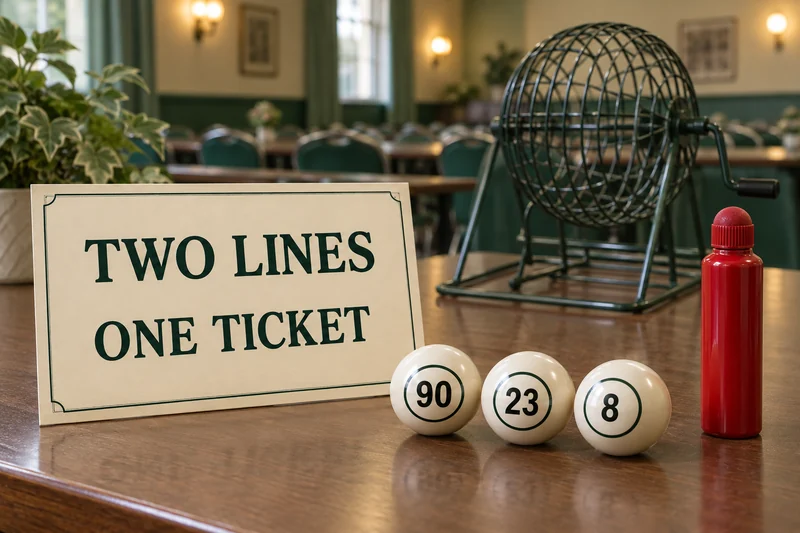
The ticket is part of the condition
Mecca’s 90-ball bingo guide describes a ticket with three rows of nine spaces, containing five numbers per row. It defines the two-line pattern as two completed horizontal rows on one ticket. The source, checked on 8 October 2026, also distinguishes the 15-number full house. Actual room prizes and validation conditions need their own rules.
Counting ten marked numbers is therefore insufficient. You need to know how they are distributed across rows and whether those rows share a ticket identity.
A complete teaching ticket
This fictional ticket T-41 is a paper example, not a playable ticket or recorded result. A dash means a blank space, not an uncalled number.
| Row | 1–9 | 10–19 | 20–29 | 30–39 | 40–49 | 50–59 | 60–69 | 70–79 | 80–90 |
|---|---|---|---|---|---|---|---|---|---|
| 1 | 3 | — | 21 | — | 42 | — | 64 | — | 82 |
| 2 | — | 14 | 25 | 31 | — | 53 | — | 75 | — |
| 3 | 8 | 19 | — | 37 | — | 58 | — | — | 88 |
If all five numbers in row 1 and all five in row 2 have been called, T-41 has two complete rows. Row 3 does not have to be complete for this geometric pattern. A full house would require all 15 numbers.
By contrast, ten marked numbers distributed as four in row 1, three in row 2 and three in row 3 complete no row. The total count is the same, but the required arrangement is absent.
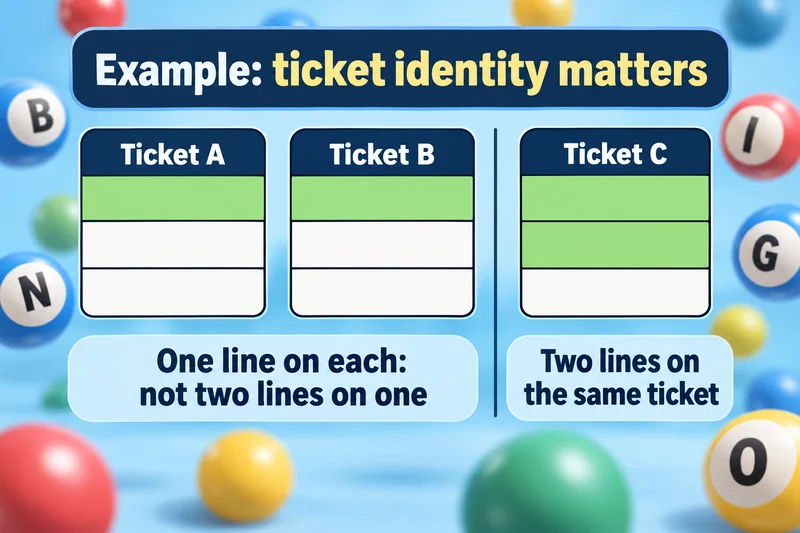
Why two tickets cannot be stitched together
Now imagine Ticket A has one complete row and Ticket B has another. Each ticket separately has one row. Moving both observations into a single notebook line does not create a new ticket with two rows.
A simple check is to keep the ticket identifier beside every completed row. “A: row 1; B: row 2” and “A: row 1; A: row 2” are different records. Only the latter has both rows attached to the same ticket in this example.
Pattern completion is not the entire prize decision
This exercise checks the arrangement of called numbers. It does not establish whether a ticket was valid for a particular round, whether the relevant prize was still available, whether another ticket completed at the same time, or whether a claim met the room’s procedure. Those are separate facts.
Keep the round, ticket identity and called-number record together. The 75-ball X-pattern comparison shows a different arrangement rule; do not transfer its square-card positions into this 90-ball format.
The lottery and number-game guide hub groups related examples. Return to the phfun homepage for the wider topic collection.
Source-based editorial research and original examples. Sources checked 2026-10-08.