
Nine bingo marks: why might X still be missing?
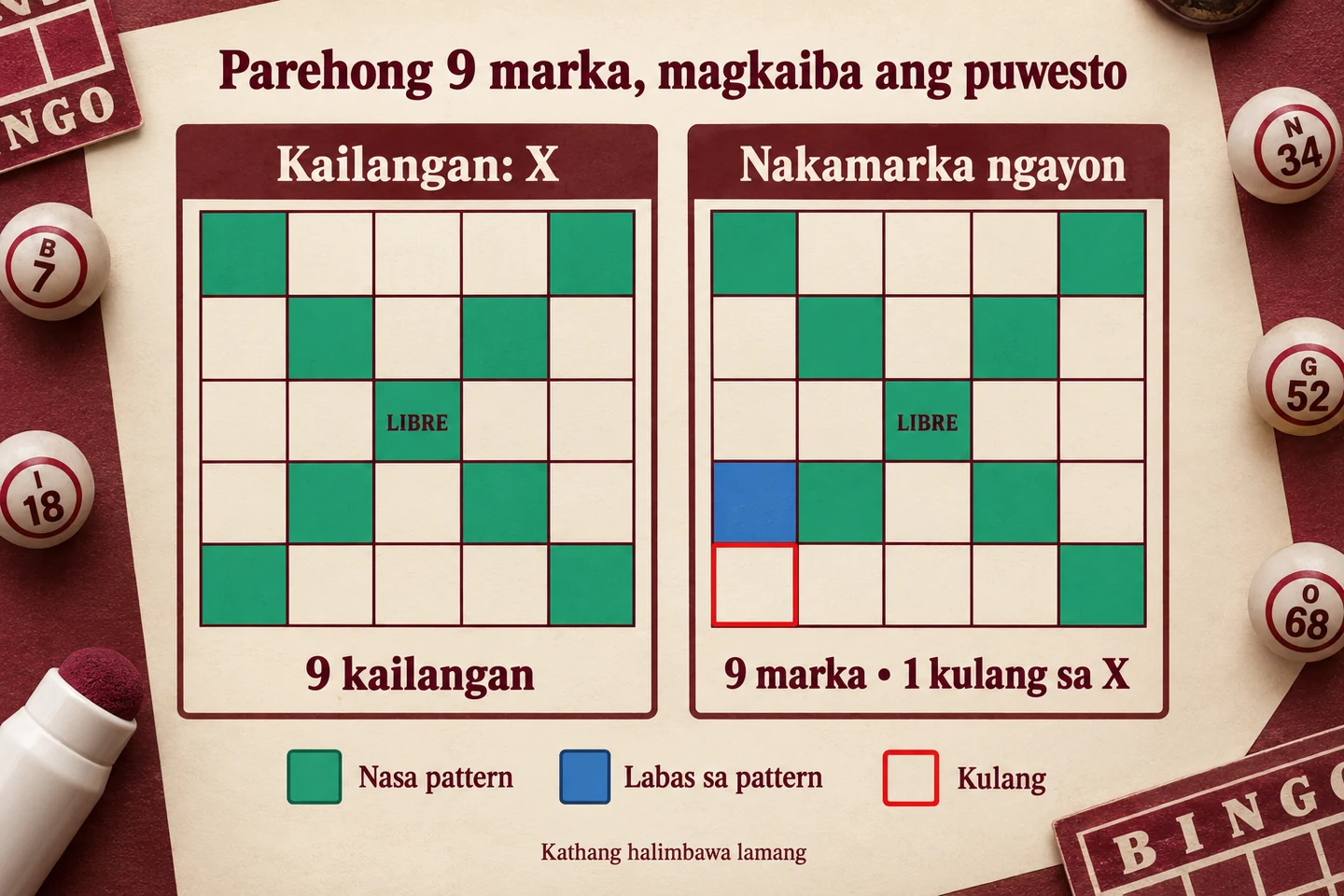
The number of marked boxes is not enough to say that a pattern is complete. Marks must be in the required places. In this example, nine are marked but one corner is still missing.
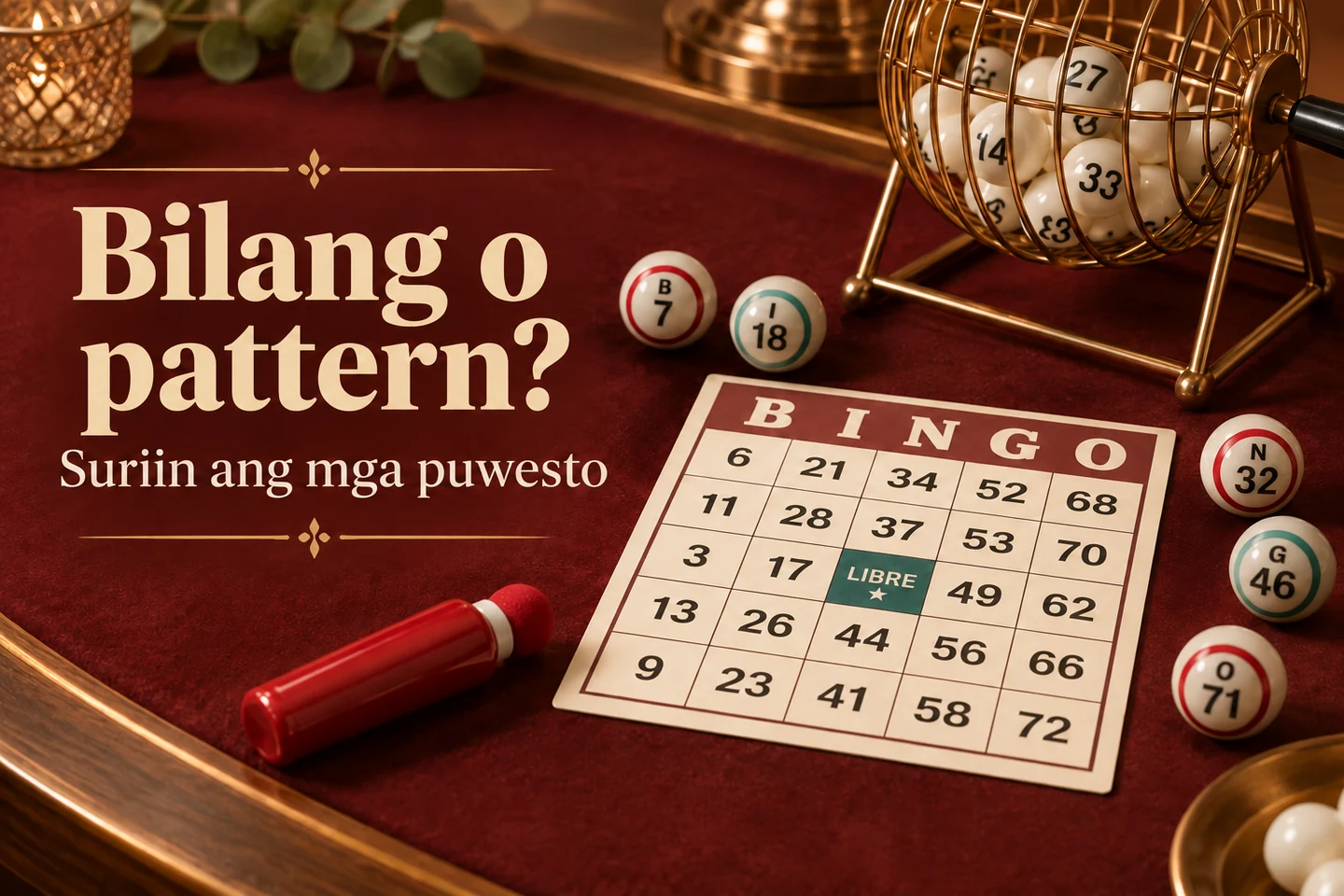
It is easy to mistake “nine marks” for “nine required marks.” The number is the same, but the reference boxes may be different. To see the difference, we read the target X and a card with an extra mark on the outside side by side.
First, set what card and pattern is being read
In Mecca Bingo’s 75-ball guide, the card has five rows and five columns. There are 24 numbers and a free box in the middle; it can be counted as marked. Columns B, I, N, G and O have the ranges 1–15, 16–30, 31–45, 46–60 and 61–75. The guide also describes the patterns that are determined before the game starts.
That’s the format we’ll be using, but our own example is X, numbers and statuses below. This is not a copy of an actual Mecca session or policy of a phfun operator. There are other bingo formats: listed by Pragmatic Play the 90-ball, 80-ball, 75-ball and other variants. So the 5×5 diagram cannot be brought to another product without reading its rules.
A card that can be checked without a bet
Let’s call it card C-17 in session S-04 this card. The selected requirement is full X: both diagonals, including the free center. We will use row 1 above to row 5 below. For example, B5 is a box in column B, row 5; it’s not called number 5.
| Row | B | I | N | Mr | Or |
|---|---|---|---|---|---|
| 1 | 2 | 17 | 33 | 47 | 62 |
| 2 | 5 | 20 | 36 | 50 | 65 |
| 3 | 8 | 23 | FREE | 53 | 68 |
| 4 | 11 | 26 | 39 | 56 | 71 |
| 5 | 14 | 29 | 42 | 59 | 74 |
Each diagonal is five boxes, but they share only one center. So 5 + 5 − 1 = 9 the unique position required. That’s eight box numbers, including the free one. If the center is counted twice, a false target of ten appears.
Nine marks, only eight covered in X
Assume that the numbers recorded in the fictitious session are 2, 20, 56, 74, 62, 50, 26 and 11. All eight of these numbers are on the card. Including the free center, nine boxes are marked.
But 11 is in B4, outside of X. What is needed in the lower left corner is 14 in B5, and that’s not even on the record. Only eight required positions are covered: seven number boxes and the free one. Mark 11 cannot be moved to box 14 just because they are both in column B.
| Situation | All marks, including free | Required positions covered | Pattern check result |
|---|---|---|---|
| 11 has, 14 doesn’t | 9 | 8 out of 9 | B5 is deficient; X is incomplete |
| In another fictitious note, 14 is the place of 11 | 9 | 9 out of 9 | X is complete; no more missing target positions |
| In the first situation, 14 will be added later | 10 | 9 out of 9 | X is complete; 11 remains an extra mark |
The second row is a separate comparison case, not allowing to change a recorded number. The third is only conditional: if add 14, X will be completed. This does not say that 14 will come up next, or that it has a higher chance because that card is missing.
The question “Which required position is missing?” is therefore more useful. than “What color is it?” The short computation is: missing = required positions that are not in the marked positions. When there is nothing left in that list, the pattern geometry is passed to our example.
The complete diagram is just a check
When holding only a screenshot, first apply it to the correct card, session and time of the result being read. The card artwork may be the same but the numbers note a different session. An X from the old round is also not enough if the current requirement is a full house.
In a real account, it is a separate question if the card is recognized as a valid entry, if that is the pattern for the current stage, and if there is an official confirmation or settlement. There is no such account evidence in this article. So “X is complete” in the table is an answer to the pattern check only; this is not a statement that a prize has already been credited.
A short note can be used: session S-04 · card C-17 · target X · marked positions · missing B5 · confirmation: not checked. When the session or current pattern cannot be found, first write “undetectable.” That’s more accurate than placing a winner based on the amount of points.
Questions that arise in comparison
Is the free center included in the nine?
Yes, in the format and rules we set. It’s a single spot, so it’s only counted once even if two diagonals pass through it. If another game does not have a free center, the analysis must be changed according to the rules themselves.
Can X be complete even if more than nine are marked?
Yes to our fictitious requirement, because it requires that X be covered; it does not prohibit extra marks. In the third scenario, ten are marked and nine are target covered.
Will the worksheet help in choosing the next number?
Nope. It checks the existing note and position on the card. It has no prediction model or information about the next draw.
Read the relevant format and own rules
Naa bingo and lottery hub the separation of draw identity and result source. For a shorter introductory explanation, read on guide to the required pattern; for other formats, return to phfun homepage and guide library. If there is a mismatched diagram on the page, the link and observation can be sent to online chat.
For a different format, the 90-ball two-line example explains why both completed rows must belong to one ticket.
Related reading
Bingo call logs: repeated records do not create extra marks | phfun