
Bingo call logs: repeated records do not create extra marks
A copied bingo call list can have more rows than distinct calls, and a card can have fewer matching numbers than either count. Repeated records do not create new marked squares. A free centre is also different from a called number, so keep those quantities separate when checking a card.
This guide in the phfun bingo and lottery section follows an invented 75-ball card and a copied transcript. The repeated rows are explicitly copies of the same call records. No live bingo session, card purchase or prize confirmation is being reviewed.
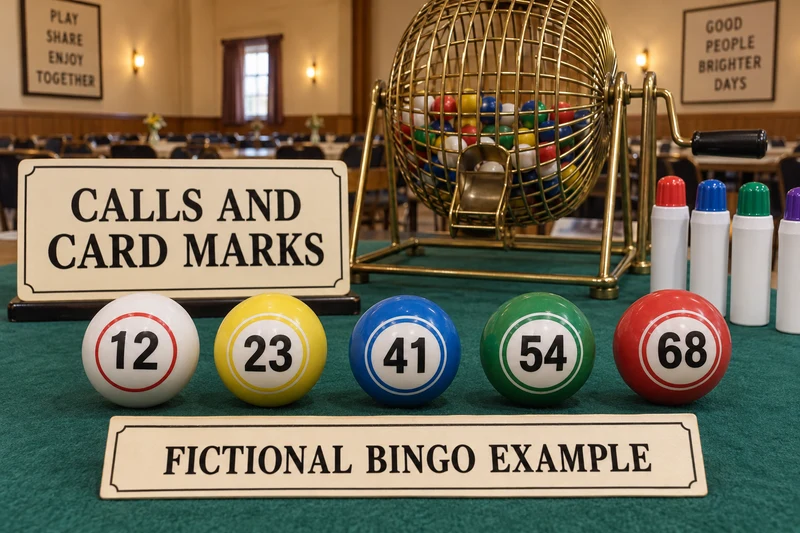
Use one identified card and one session
Mecca’s 75-ball guide describes a five-by-five card with 24 numbers, a centre treated as marked, and the B, I, N, G and O column ranges. Its format description is the reference here. The card, session and transcript below are newly constructed examples, not a Mecca record or a claim about availability on phfun.
Call the fictional card C-29 in session S-12. Rows run from top to bottom. A label such as B3 means column B, row 3; it is a location on the card, not a call for number 3.
| Row | B | I | N | G | O |
|---|---|---|---|---|---|
| 1 | 5 | 17 | 31 | 46 | 61 |
| 2 | 9 | 23 | 35 | 50 | 64 |
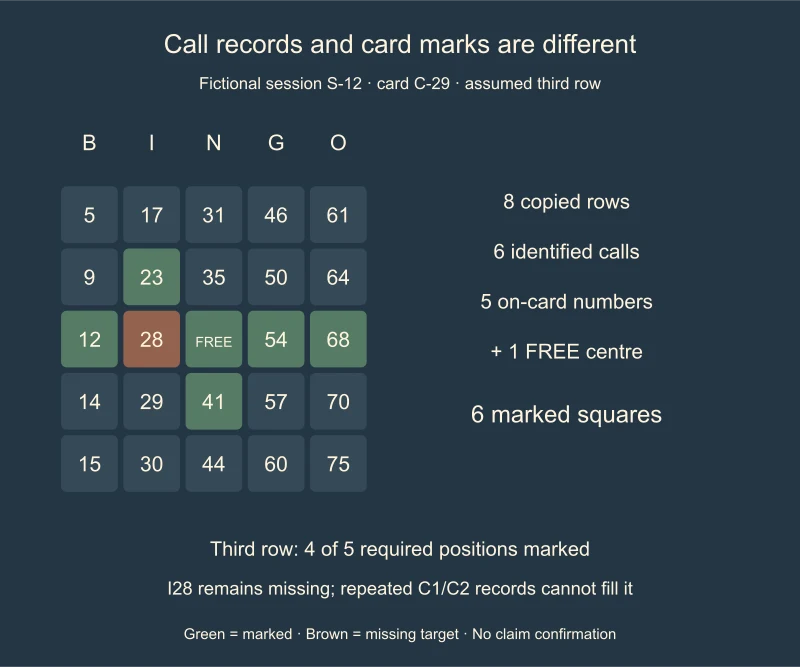
| 3 | 12 | 28 | FREE | 54 | 68 |
| 4 | 14 | 29 | 41 | 57 | 70 |
| 5 | 15 | 30 | 44 | 60 | 75 |
Eight copied rows contain six call records
The transcript rows read C1: B12; C2: I23; C3: N41; C4: G54; C5: O68; C1: B12 again; C6: O72; C2: I23 again. All belong to S-12. The second C1 and C2 rows repeat the same identified calls, rather than record new draws.
There are eight copied rows, six distinct call IDs and six distinct called numbers: 12, 23, 41, 54, 68 and 72. Only five of those numbers occur on C-29. The number 72 is a valid O-range number but is absent from this particular card.
| Quantity being checked | Count | Reason |
|---|---|---|
| Copied transcript rows | 8 | C1 and C2 each appear twice |
| Distinct identified calls | 6 | C1 through C6, once each |
| Called numbers on C-29 | 5 | 12, 23, 41, 54 and 68 |
| Marked positions including FREE | 6 | Five matching number squares plus one centre |
A repeated call cannot fill a different square
B12 marks B3 on this card. Seeing the same C1 record again still refers to B3. It does not mark B4, move the mark to another column or supply the missing I28. I23 similarly marks I2 only once.
The free centre N3 is marked under the example’s format assumption. It is not a seventh call or a second occurrence of a called number. Count it once as a marked position when the required pattern includes it, while keeping it outside the called-number total.
Six marks still do not complete the assumed third row
For a separate pattern check, suppose the fictional requirement is the full third row: B3, I3, N3, G3 and O3. The transcript covers B3 with 12, G3 with 54 and O3 with 68, and the free centre covers N3. I3, containing 28, is missing. Four of the five required positions are marked.
The marks at I2 and N4 are outside this row. The card has six marks in total, but that does not move those two marks into the missing position. The worked X-pattern guide explains why overall mark count and required pattern coverage are different checks.
Keep the original transcript when resolving repeats
For this example, the duplicate key is session plus call ID, with the same value attached. Preserve the eight raw rows and create a separate working list of the six identified calls. That allows another reader to see why two rows were excluded from the working count.
Do not remove every repeated number across an entire file. The same number can appear in a different session, and a corrected record may need a version history. If the same session and call ID have conflicting values, mark the conflict and check the source; this guide does not authorize choosing whichever value completes a pattern.
Keep the conclusion within what the record shows
The result of this worksheet is: eight copied rows, six distinct calls, five called numbers on C-29, six marked positions including FREE, and one missing position for the assumed third row. Those are different quantities, so none should silently replace another in a caption.
Actual entry validity, the announced pattern and any confirmation or settlement require their own records. Source, card ranges and set checks completed on 10 October 2026. No missing call was guessed and no next-number prediction was made.